
How to Revoke and Rotate Exchange API Keys Safely
To rotate exchange API keys safely without interrupting automated trading operations, generate a new secondary API key pair on your exchange, input the new credentials into your management system, verify successful authentication, and immediately delete the legacy key pair. This dual-key overlap process prevents operational downtime while completely neutralizing old or potentially exposed API credentials.
Not for you if you only execute manual spot trades through official exchange web interfaces or mobile applications without connecting external software tools.
Why should you regularly rotate exchange API keys?

Maintaining long-term API key credentials introduces significant operational risk to cryptocurrency accounts. According to Chainalysis crypto security reporting, unauthorized API access accounts for a major portion of automated asset compromises across centralized platforms. API keys function as permanent password substitutes, granting software scripts direct access to perform actions on your behalf.
Third-party trading bots, portfolio tracking tools, and tax platforms store these credentials on remote servers. If a software vendor experiences a database exposure, unauthorized users can access stored key pairs. Regular rotation ensures that leaked secrets become useless quickly, limiting exposure windows. Rotating credentials also purges legacy connections from abandoned applications, preserving strict control over account permissions.
Key Takeaways
- API key rotation limits the time window an exposed credential remains actionable by unauthorized parties.
- Periodic updates eliminate legacy access granted to abandoned trading software or tax tracking platforms.
- Restricting permissions and enforcing IP bounds provides vital protection alongside regular key replacement.
How do you rotate exchange API keys without trading downtime?

Executing an API key replacement requires a structured sequence to avoid missed trades or broken execution channels. Deleting an active API key before setting up its replacement causes instant software failures and connection loss. To maintain continuous service, deploy a dual-key migration routine.
Follow this verified step-by-step procedure to complete a zero-downtime key replacement:
- Log into your exchange account and navigate directly to the API Management console.
- Generate a new API key pair using an explicit label matching your target application.
- Set exact permissions required for operation, avoiding administrative or withdrawal rights.
- Bind the new key pair to your fixed server IP addresses in the restriction field.
- Save the generated API secret key immediately in a secure, encrypted vault.
- Copy the new API key and secret into your trading application configuration.
- Initiate a application reload or restart sequence on your trading host.
- Monitor system logs to verify successful API requests and balance checks.
- Delete the legacy API key on the exchange console after confirming stable activity.
Below is an operational comparison detailing standard approaches to key updates:
| Rotation Approach | Service Downtime | Operational Risk | Recommended Use Case |
|---|---|---|---|
| Hard Cutover (Delete then Create) | 5 to 15 minutes | High (missed executions, script errors) | Emergency containment of active leak |
| Dual-Key Overlap (Create, Swap, Delete) | Zero downtime | Low (controlled rollback capability) | Standard scheduled routine maintenance |
| Staging Server Validation | Zero downtime | Very Low (isolated environment test) | Complex high-frequency execution bots |
Quick Summary
- The dual-key overlap method maintains uninterrupted trading while replacing system credentials.
- Testing read and trade permissions before revoking old keys prevents unexpected script failures.
- Explicit IP binding remains mandatory during every single credential replacement cycle.
What are the limits and downsides of frequent API key rotation?
While rotating credentials enhances system protection, high-frequency key replacement introduces explicit administrative friction and operational limits.
First, frequent key creation increases administrative overhead when managing static IP access lists. Each new key must be manually bound to specific server IP addresses on the exchange interface. Operators managing multiple automated trading nodes across different locations face configuration fatigue, raising the likelihood of manual entry errors.
Second, provisioning new keys resets active connection sessions and nonce sequences. Certain exchanges enforce brief rate-limit restrictions or signature sync delays on newly activated keys. Reconnecting streaming market feeds with new credentials during periods of elevated volatility can lead to temporary request throttling.
In Short
- Frequent rotation increases administrative overhead and manual IP configuration tasks across trading nodes.
- Newly provisioned API keys can experience brief exchange rate-limiting or nonce synchronization adjustments.
- Over-rotating without automated scripts creates opportunities for manual configuration errors.
How do you safely revoke compromised or unused exchange API keys?
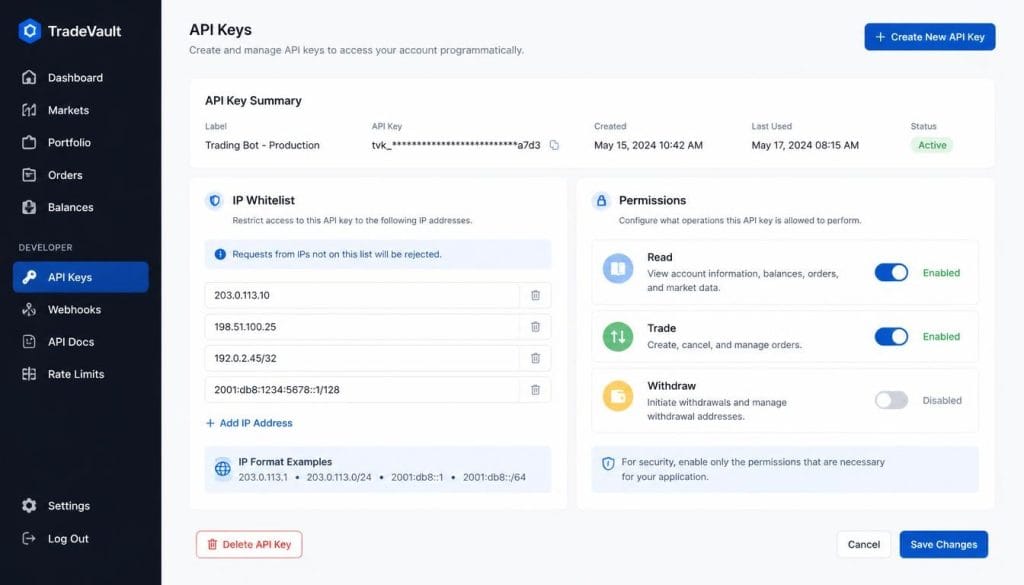
If you suspect an API key exposure or decide to disconnect a trading application, immediate deletion is necessary. Removing local configuration files from your server is insufficient, because the key remains fully authorized on the exchange server.
As documented in Binance security guidelines, revoking an API key immediately invalidates all active sessions and signed authentication requests associated with that secret. Execute this revocation process to isolate your account:
- Access the exchange API management interface from a secure device.
- Locate the target key entry corresponding to the compromised or obsolete service.
- Click the explicit Delete or Revoke button next to the key entry.
- Confirm key removal using multi-factor authentication codes.
- Review active order books on the exchange to ensure no unauthorized limit orders remain active.
- Terminate the server process linked to the revoked key to prevent continuous failed request logs.
Bottom Line
- Deleting local server files does not cancel exchange-side API permissions.
- Immediate revocation from the exchange interface stops all pending and future signed requests.
- Always inspect open orders and balance movements immediately after revoking any active key.
What common errors occur when you rotate exchange API keys?
Operators frequently encounter technical mistakes during credential updates. Recognizing these failure points ensures smoother maintenance procedures.
One primary error is leaving IP address access open or unrestricted. Generating an API key without specific IP restrictions enables request execution from any global location. If an unrestricted key leaks, external entities can interact with your account instantly.
Another issue is assigning excessive access rights to automated tools. Automated execution strategies rarely require withdrawal or asset transfer capabilities. Enabling unnecessary permissions inflates risk exposure without providing operational benefits.
Finally, storing secret keys in unencrypted source repositories creates immediate vulnerability. Automated web indexing tools actively scan public code repositories for raw credentials, leading to fast account compromises if secrets are published.
Key Takeaways
- Never leave IP restrictions disabled when generating new API keys for automated software.
- Enforce strict scope limits by disabling withdrawal and transfer capabilities on trading keys.
- Store secrets in encrypted environment vaults rather than plain-text files or public code repositories.
What is the recommended checklist for API key maintenance?
Execute this verification checklist during every maintenance cycle to ensure system protection and operational continuity:
- Verify that all active API keys have explicit IP address whitelists assigned.
- Confirm that no active trading API key holds balance withdrawal permissions.
- Delete all unassigned or legacy API keys from the exchange interface immediately.
- Encrypt stored API secrets on application servers using local hardware vaults or environment modules.
- Schedule routine API key updates every 90 days using the dual-key overlap sequence.
- Confirm multi-factor authentication requirements for key generation and modification settings.
Frequently Asked Questions
How often should I rotate my exchange API keys?
You should rotate exchange API keys every 60 to 90 days as part of standard operational hygiene. However, you must rotate them immediately if you suspect an exposure, terminate a third-party trading service, or change hosting infrastructure. Regular rotation limits the window of vulnerability if credentials are compromised in external software databases or system backups.
Will revoking an API key cancel my open trading orders?
Revoking an API key stops the key from placing new orders or modifying existing ones. On most exchanges, active limit orders previously placed by that key remain open on the order book unless explicitly canceled. To clear all actions, you must cancel open orders manually through the exchange interface or issue a bulk cancellation command before revoking the key.
Can an API key withdraw funds from my exchange account?
An API key can only withdraw funds if the account holder explicitly enables withdrawal permissions during key generation. By default, major cryptocurrency exchanges disable withdrawal rights on new API keys. To maximize security, you should never enable withdrawal permissions for third-party trading bots or automated analytics platforms.
What happens if I delete an API key while a trading bot is running?
If you delete an active API key while a trading bot is running, subsequent API requests will fail with authentication errors. The bot will be unable to fetch market data, execute trades, or adjust stop-loss levels. To avoid unexpected behavior, always deploy a new key first before revoking the legacy credentials.
What is an API key IP whitelist and why is it necessary?
An API key IP whitelist restricts key usage to specific, pre-approved IP addresses. Even if an unauthorized party obtains your API key and secret, the exchange will reject all requests coming from unapproved IP addresses. Enforcing an IP whitelist is one of the most effective defensive measures for automated trading infrastructure.
How do I safely store my exchange API secret key?
Store exchange API secret keys in encrypted password managers or dedicated secret management systems such as environment vaults. Never store plain-text API keys in software source code, public repositories, or unencrypted text documents. Restrict read access to application configuration files so only authorized system processes can access the credentials.