
Bitcoin Halving Explained: Historical Impact and What to Expect Next
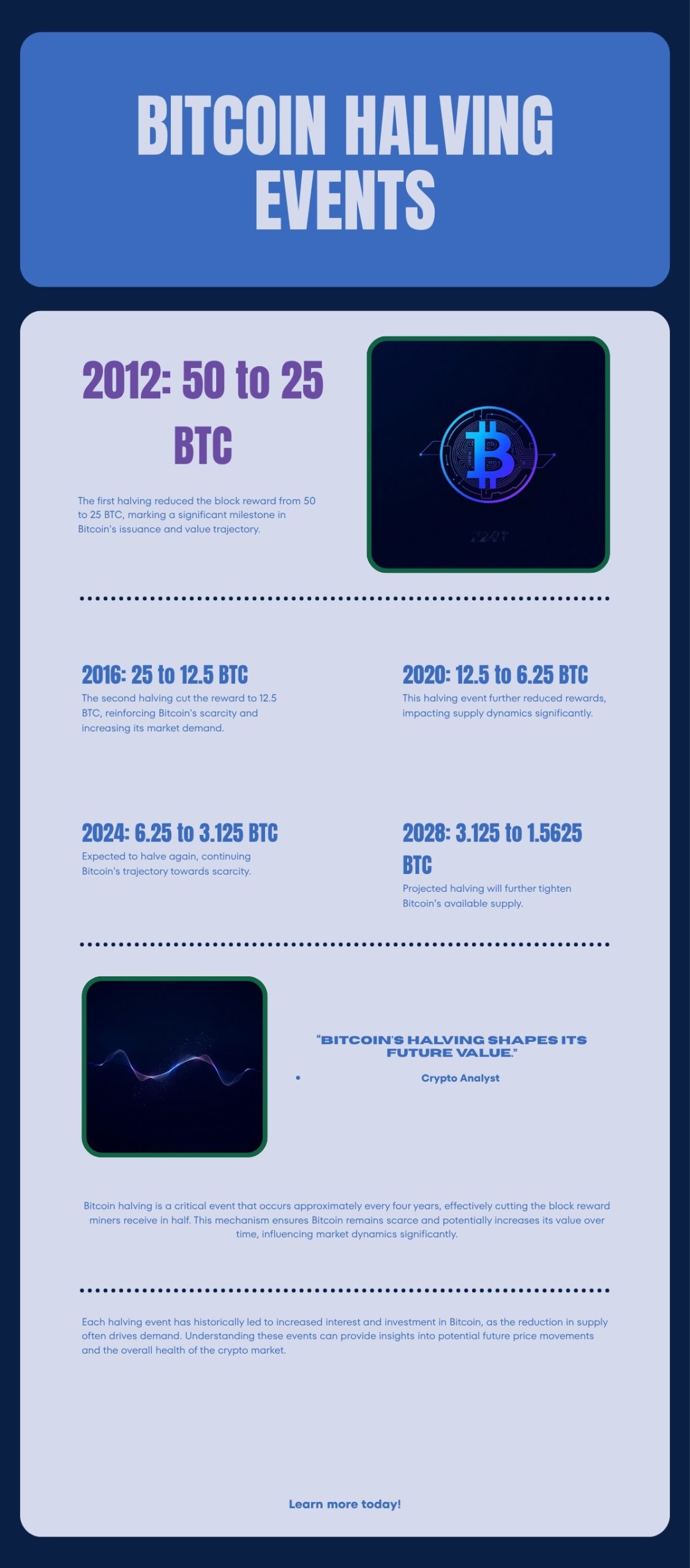

Bitcoin halving explained simply: roughly every four years, the Bitcoin protocol cuts the reward miners earn for confirming a new block exactly in half. That single, pre-programmed rule change ripples through mining economics, exchange order books, and long-term supply math in ways that unfold over months, not hours. This piece walks through the mechanism itself, what the last three halvings actually did to price and mining revenue, and what the 2028 halving is likely to change for the people who mine, hold, or simply watch the market from the sidelines.

At a Glance
- Most recent halving: April 19-20, 2024 — block reward cut from 6.25 BTC to 3.125 BTC
- Primary driver of the current cycle: Spot Bitcoin ETF demand, which has absorbed more than 1.13 million BTC since approval
- Overall risk level: Elevated and asymmetric — outcomes vary sharply between well-capitalized miners and everyone else
What Actually Happens When Bitcoin Halves
Bitcoin’s issuance schedule is fixed in code. Every 210,000 blocks, mined roughly every four years, the reward paid to whoever confirms a block drops by 50%. That is the entire mechanism. There is no vote, no committee decision, and no room for adjustment — the halving happens whether the market is ready for it or not.
The immediate effect is on the supply side only. Fewer new coins enter circulation per day. Demand is untouched by the halving itself. Whatever happens to price afterward comes from how buyers, sellers, and miners react to that slower supply growth — not from the halving directly setting a new price.
This distinction matters because halving-adjacent content often blurs mechanism with outcome. The mechanism is simple and certain. The outcome is not.
The Historical Data: Three Halvings, Three Different Markets
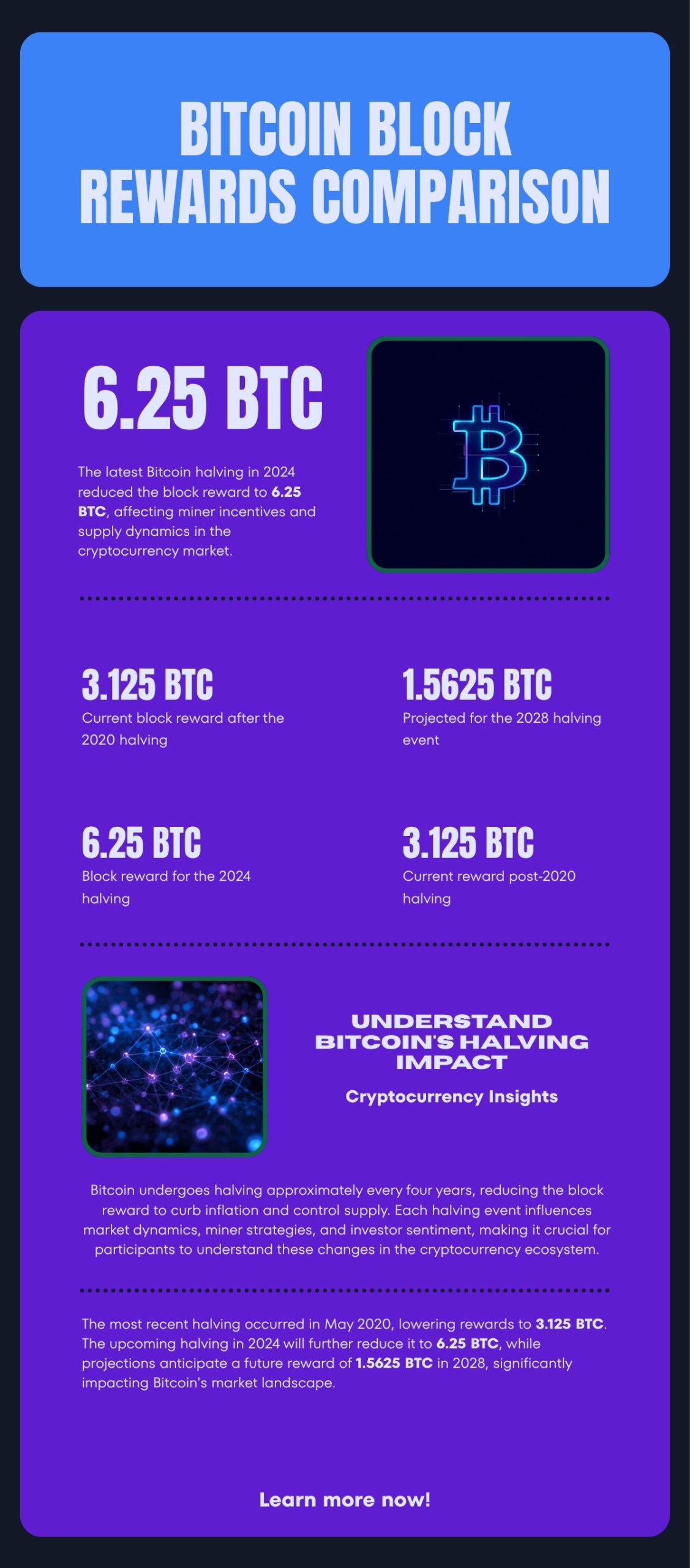
The 2024 halving cut the block reward from 6.25 BTC to 3.125 BTC. Bitcoin was trading near $64,000 at the time, roughly a month after touching an all-time high above $73,800 in March 2024. That timing alone sets this cycle apart from 2012 and 2016, when halvings happened in relatively obscure, retail-dominated markets.
The structural difference in 2024 was institutional access. Spot Bitcoin ETFs launched in the U.S. just months before the halving and have since absorbed more than 1.13 million BTC. Previous cycles were driven almost entirely by retail flows reacting to halving narratives online. This cycle added a large, semi-permanent institutional buyer that does not trade the same way retail does.
What this data shows: institutional demand changed who is buying, not whether halvings automatically produce a rally. What it does not prove: that ETF flows guarantee upside, or that this pattern repeats identically in 2028. Demand structures shift between cycles, and treating one halving’s dynamics as a template for the next is exactly the kind of speculative leap this analysis avoids.
Key Takeaways
- The 2024 halving cut new BTC issuance in half, as designed
- ETF-driven institutional demand was the defining new variable, not the halving mechanism itself
- Price movement after a halving reflects demand response, not the halving directly
Why Miners Are Being Squeezed Differently This Cycle
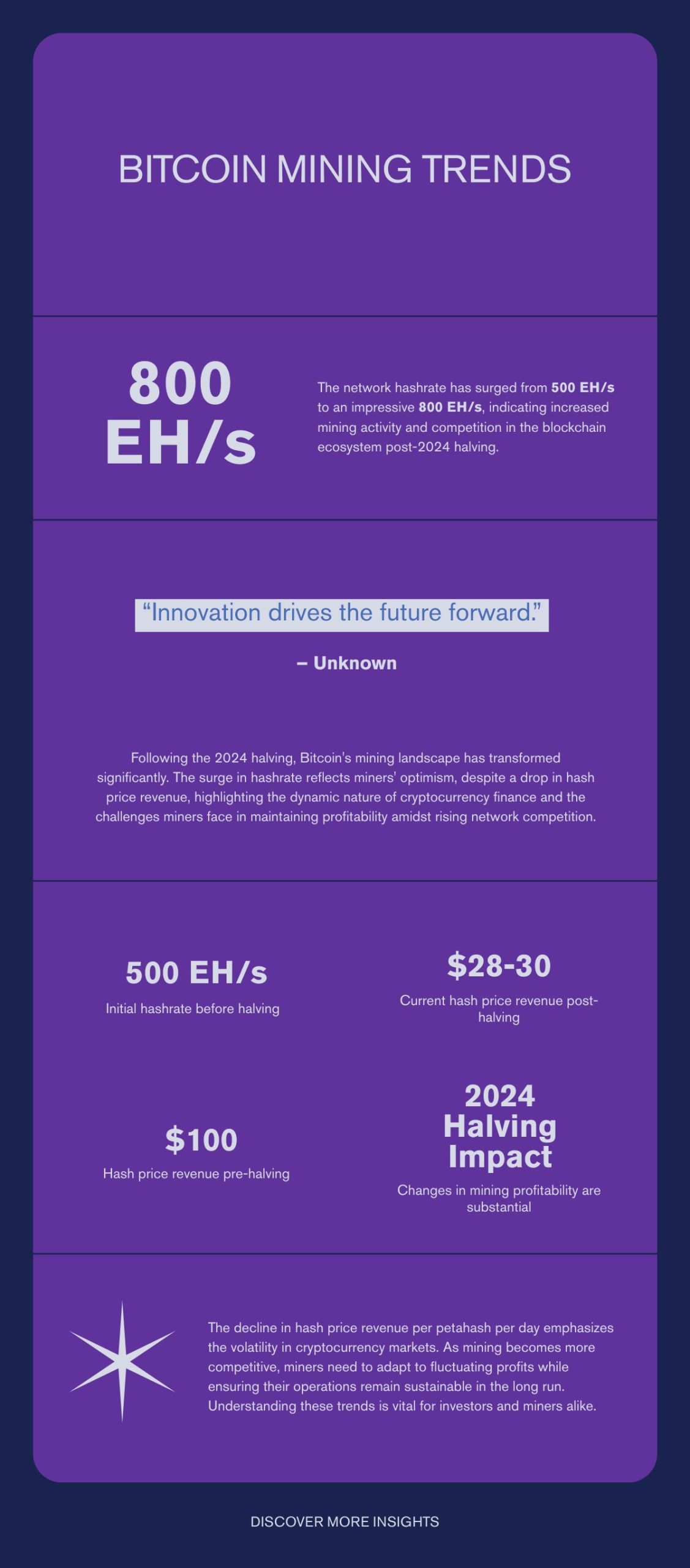
Halvings hit miners first and hardest, because block rewards are their primary revenue line. After the 2024 halving, revenue per petahash per day fell from over $100 to roughly $45-$55, and by early 2026 some data put hash price as low as $28-30 per PH/s per day — a new post-halving low.
At the same time, network hashrate did not fall. It rose, surpassing 800 EH/s at points in early 2026, up from around 500 EH/s at the time of the 2024 halving. That combination — falling revenue per unit of computing power, rising total computing power — is the core tension of post-halving mining economics.
The explanation is competitive: miners with cheap electricity and efficient hardware kept expanding because their margins still worked. Miners running older machines, typically anything consuming more than roughly 25 joules per terahash, increasingly could not cover costs at prevailing electricity rates and were pushed out or absorbed. The implication is a market bifurcating into a smaller group of highly efficient operators and a shrinking tail of marginal ones — not an industry-wide collapse, and not an industry-wide boom either.
Bottom Line
- Post-halving revenue per unit of hashpower dropped sharply, then kept falling into 2026
- Total network hashrate still climbed, driven by efficient, well-capitalized operators
- Older, less efficient mining hardware is the segment most exposed to further halvings
What the 2028 Halving Could Look Like
The next halving is expected around block height 1,050,000, currently projected for mid-April 2028. The block reward will fall again, from 3.125 BTC to 1.5625 BTC. That much is close to certain, since it follows directly from the fixed issuance schedule.
What is not certain is price or mining economics at that point. Some analysts have floated price targets in the $250,000 range ahead of the 2028 halving, based on extrapolating prior cycle patterns. That kind of projection is a scenario, not a forecast this piece treats as likely or unlikely — three data points (2012, 2016, 2020, 2024) is a thin sample for drawing a repeatable curve, and each cycle has arrived with a meaningfully different market structure around it.
For mining economics specifically, the same bifurcation trend observed after 2024 is likely to continue: further reward cuts favor operators with the lowest electricity costs and newest hardware generations, and continue squeezing out marginal miners regardless of where price ends up.
In Short
- The 2028 halving reward cut (3.125 → 1.5625 BTC) is fixed by protocol, not speculation
- Long-range price targets tied to halving cycles are scenario analysis, not reliable forecasts
- Mining hardware efficiency will likely matter more with each successive halving, not less
Who Should Pay Attention to This — and Who Can Safely Ignore It
Active or prospective miners have the most direct stake here: halving-driven revenue compression is a planning input for hardware purchases and electricity contracts, not background noise. Long-term holders evaluating Bitcoin’s supply mechanics may find this useful context, but the halving itself is not a timing signal — treating it as one has historically led to buying and selling based on a date rather than on demand conditions, which are the actual variable that moves price.
Short-term traders looking for a mechanical edge from halving dates specifically are likely to be disappointed; the effect, if any, plays out over months through changing supply-demand balance, not as a predictable event-driven price spike.
Next Step
- Check current network hashrate and mining difficulty against your own hardware’s efficiency (joules per terahash) before assuming post-halving profitability
- Review your exchange or custody setup independent of any halving-timing assumptions
- If evaluating mining hardware, verify current-generation efficiency benchmarks rather than relying on pre-halving cost assumptions
- Treat any specific price target tied to a halving date as a scenario to weigh, not a plan to act on
| Source / Website | Purpose |
|---|---|
| VanEck Digital Assets Research | Institutional analysis of halving mechanics and 2024 cycle context |
| CoinShares Research | Quarterly bitcoin mining industry data, including hash price and revenue trends |
| Fidelity Digital Assets | Miner-focused economic analysis of halving cycles |
Further Resources & Tools
| Resource | Purpose |
|---|---|
| CoinWarz Halving Countdown | Real-time countdown and block height tracker for the next halving |
| Ledger hardware wallet (Amazon) | Cold storage option for long-term BTC holdings |
| Trezor hardware wallet (Amazon) | Alternative cold storage option |


